
The 5 Pillars of Settling into Perth
The guide that doesn't sell you the dream — it lands it. A practical structure so your transition is a clearer path instead of a series of stumbles.
This is what took many of us months, or years, to work out. No decoration, and written by people who have been there.

The five pillars
Figures checked in May 2026. Prices move — treat them as an order of magnitude, not a budget.

Day-to-day life
Transport, banks, registrations.
The first thing to sort, because you use it every day from the moment you land. Getting around, eating, and having an account for your wages to arrive in.
Public transport
Perth has a reliable system. Transperth runs buses, trains and ferries across the city, and once you understand how it works everything gets easier.
- "Go Anywhere" fare
- $3.50 cash · $3.15 with SmartRider · $2.80 with SmartRider Autoload.
- CAT buses
- Free inside the CBD, in the Free Transit Zone. Learn where the zone is — it saves you the short daily trip.
- DayRider
- $7.00 — worth it on days with a lot of trips.
- TAFE or university students
- Ask for your Tertiary SmartRider and pay $1.60 per trip, or $1.28 with Autoload. That is 20 % off your transport.Student SmartRider
- Register your card
- A registered SmartRider can be recovered if you lose it, and registration is what enables Autoload.How to register it
- Plan your routes
- The Transperth app or Google Maps. Both work well here.
| Expense | What to budget |
|---|---|
| Transport | AUD $90–110 a month, on SmartRider Autoload on weekdays |
| Groceries | AUD $270 a month, cooking at home |
| Utilities | AUD $150–200 a month, sharing a place with internet included |
| Single room, metro area | AUD $250–350 a week |
| Health cover | AUD $100–120 a month. Mandatory on a student visa |
Approximate prices as of May 2026. They vary by suburb and market conditions. Sources: Transperth, REIWA and Numbeo Perth.
- SpudshedVery cheap, especially after 9 PM. Local produce that spoils faster — buy and freeze. Great for fruit and veg, weak on meat.
- AldiCompetitive prices. Limited fruit and veg range, but excellent dairy and packaged goods. Watch the seasonal aisle.
- Coles and WoolworthsThe big two. Slightly pricier, with more range and consistent quality. Use the loyalty cards.
- MCQ MarketsAmong the cheapest and freshest you will find. The Morley one stands out for seasonal fruit.
- Bank account. CommBank, ANZ and NAB waive fees if you state that you are a student. You need your passport, visa and a local address. UP Bank is fully digital, fee-free and easy to use.
- Phone. Do not sign anything at the airport. Telstra and Optus are expensive; Aldi Mobile and Felix Mobile are prepaid and let you control the spend. Avoid long commitments until you are settled.
- Internet. Felix offers unlimited data, which saves you paying for home internet. No lock-in contract, and you can suspend it if you travel.

Work and your rights
Contracts, certificates, the job hunt.
The part that presses hardest when you arrive: finding work. And it is not only about handing out CVs. You need to understand how the system moves and what rights you have from day one. There are jobs, but you also have to know how to protect yourself.
- CasualNo fixed hours, with 25 % extra per hour. Very common for students. Flexible but unstable.
- Part-timeRegular hours. Less per hour than casual, but with pro-rata leave.
- Full-time38 hours a week and full benefits. Requires a visa with full work rights.
What they owe you
- Minimum wage
- AUD $26.44 an hour, $1,004.90 a week, from July 2026.
- Super
- Paid on the same day as your wages, not quarterly. Check it on your payslip.
- Penalty rates
- Weekends, public holidays and more than 7.6 hours straight are paid extra.
- Students on a visa
- A maximum of 48 hours per fortnight while the semester is running.
TFN — your tax file number
The first thing to get. Without a TFN they withhold up to 45 % in tax.
- It is free
- Apply at ato.gov.au and it arrives in about 28 days. You do not need a middleman and you should not pay anyone.Apply for a TFN
Certificates that open doors
- RSA
- Required to work with alcohol. Online from around $25 AUD; in person, $80. In Western Australia it does not expire.
- White Card
- Required for construction. Online from $39 AUD. Create your free USI at usi.gov.au before enrolling.
- ABN
- Free at abr.gov.au. You need it for tutoring, cleaning, gardening or any freelance work.Apply for an ABN
- 1
Write an Australian CV
- No photo and no country of origin — they are not used here.
- Your name and how to contact you, nothing else.
- Add your current Perth suburb: being close to the job counts in your favour.
- 2
Research before you apply
- Look at what they do, their hours and their services.
- Knowing the place’s vocabulary changes the interview.
- 3
Turn up in person
- Dressed in black, at quiet hours.
- Always ask to speak to the manager.
- A message never replaces turning up. Showing interest face to face can get you a trial the same day.
Facebook groups where jobs get posted
Do not stop at these, but they are a good place to start: people post every day, and plenty of openings never reach the job boards.
- PERTH JOBS
- The biggest and most general. Openings across every sector in Perth.Open the group
- JOB HUNT — PERTH
- Openings, and people offering themselves too. Useful for seeing how others pitch.Open the group
- WA Restaurant Staff
- Hospitality across Western Australia: kitchen, bar and floor. Where most new arrivals get their first job.Open the group

Housing
Where to look, the bond, the traps.
You arrive in a new country and the first thing you want is your own space, somewhere to sleep in peace. But rent is your biggest expense, and choosing badly makes everything harder.
When you land, find something temporary near your school or your work. Do not rush into renting on your own.
| Type of place | Weekly cost | For | Against |
|---|---|---|---|
| Shared room | AUD $200–250 | The cheapest option | No privacy, possible friction |
| Private room with shared areas | AUD $250–400 | Split bills and company | Less privacy |
| Studio on your own | From AUD $600 | Complete independence | High cost and early loneliness |
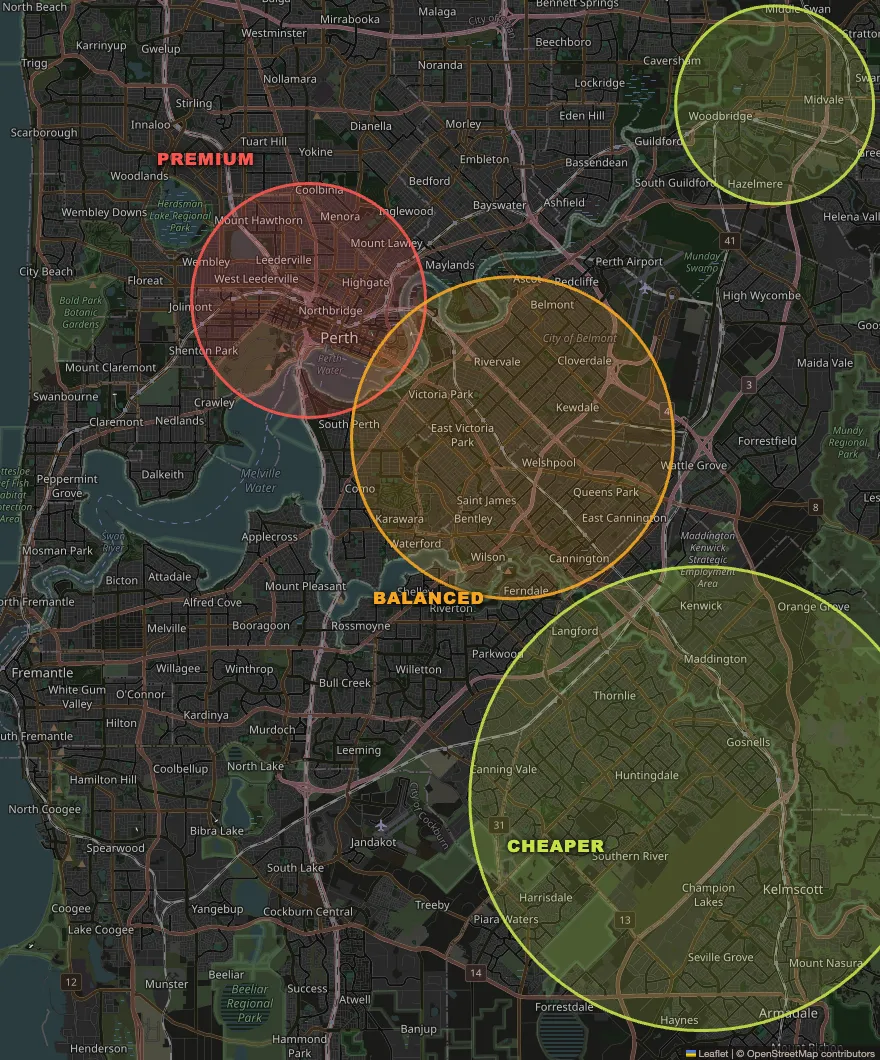
Cheaper
- Armadale
- Gosnells
- Thornlie
- Kenwick
- Midland
Further out and cheaper. Look for places near train stations.
Balanced
- Rivervale
- Belmont
- Bentley
- Victoria Park
- Cannington
The best price-to-transport ratio.
Premium
- Northbridge
- CBD
- Subiaco
- Leederville
- Mt Lawley
The most expensive, but the best located.
- The bond is 2–4 weeks of rent. Always lodge it officially.
- If you are only renting a room, document the agreement over WhatsApp or Messenger. At minimum.
- If you are renting the whole place, insist on a written contract. No exceptions.
- Keep the Facebook post if that is how you found the room — it works as backup.
Plenty of Latin Americans have lost their bond for having no proof. Do not be one of them.
Where to look
- Facebook Marketplace and groups
- Search "Latinos en Perth" or "Accommodation Perth". Fastest and most direct.
- Flatmates.com.au
- More formal. Ideal if you already have a firm arrival date.
- Realestate.com.au and Domain.com.au
- For formal long-term leases.
Facebook groups where rooms get posted
The fastest and most direct route, and also the one to watch: always get proof of the agreement, and never pay before seeing the place.
- Perth Rental Community — Listings & Support
- Listings, plus people answering questions about leases and bonds.Open the group
- Perth — Houseshare / Flatshare / Room for Rent
- Rooms and shared flats. The busiest one day to day.Open the group
- Perth Rooms For Rent
- Rooms only. Useful when you need something temporary right after landing.Open the group

Networking
Build your network and your community.
Straight up: everything here works through connections. Meeting people can be the difference between finding work this month or waiting six more.
- Local eventsFairs, festivals and free activities run by the Perth councils.
- Campus lifeStudent clubs and conversation groups at your institution.
- Your people are here tooDances, get-togethers and cultural celebrations. Your emotional safety net.
- Digital platformsMeetup, Eventbrite and Facebook groups organised by industry.
TipYou do not have to live glued to your own community, but knowing where it is is worth gold. There are moments when only someone from where you are from gets a joke, a dish or a tradition without you having to explain anything. Know where to find it for when you need it.
Free English groups in PerthAbout 40 groups and classes every week, mostly in libraries and with no visa conditionDigital tools
- Eventbrite
- Workshops, expos and industry networking. Ideal for getting into your professional field.
- Meetup
- Interest groups: photography, hiking, languages, programming.
- Update your profile in English. Many openings circulate by internal referral and are never posted.
- 1
Pick two activities
- Ones you genuinely enjoy that also put you near people.
- 2
Book one event a fortnight
- A social one, minimum. Put it in the calendar or it will not happen.
- 3
Be genuine
- Real interest shows. So does the fake kind.
- 4
Follow up
- An occasional message keeps the connection alive.
TipEventbrite and Meetup are not only for social events. Look for conferences, workshops and industry meet-ups. Showing up early puts you on the radar of key people before you are actively job hunting. A conversation at the right moment opens doors a CV cannot.
In Australia the best prepared does not always win. The best connected does.

The emotional side
The human part of migrating.
Perhaps the most underestimated pillar, and one of the most decisive. This is not about paperwork — it is about what happens inside. However many pretty videos you have seen, migrating is not only beaches, nice cafés and clear skies.
Once you land and start living day to day, a lot of expectations fall apart. Not because you are failing, but because what you saw was the surface everyone shares. Migration has grey areas too: loneliness, frustration, tiredness and homesickness.
Accept that your plan will change
And that is fine. Flexibility is a key migrant skill. Adjusting your steps does not mean you are lost — it means you are adapting.
Build your emotional support network
You do not need to surround yourself only with Spanish speakers, but you do need at least two people you can be yourself with. Speaking English is one thing; unloading in your own language with someone who understands your context is another.
Distance is felt more as time passes
Your friends and family are there and you are here. It is not indifference — it is the time difference and different routines. That is why building new ties in Australia is not a luxury, it is a necessity.
Do not normalise feeling bad without saying it
Sometimes you just need to talk. If you feel you have no one to unload on, write to us and we will arrange a confidential conversation with someone on the team. You are not on your own.
The five pillars at a glance
Everything worth remembering, on one screen.
Day-to-day life
Transport, banks, registrations.
Work and your rights
Contracts, certificates, the job hunt.
Housing
Where to look, the bond, the traps.
Networking
Build your network and your community.
The emotional side
The human part of migrating.
Settling in is not only surviving — it is finding your new way of living. These five pillars save you time, money and grief.
Did it help?
This guide is free and it stays free. We wrote it because nobody wrote it for us. If it saved you a rough patch, a badly signed lease or a month of going in circles, buy us a taco.
You decide how much. Secure payment via Stripe.